
/ About this event
Building Intelligence for the Physical World
The next frontier of AI will not be confined to a browser. It will have to perceive the world, understand space, make decisions under uncertainty, interact with hardware, and operate reliably in environments that do not behave like a benchmark.
That changes almost everything.
Models now have to contend with sensors, latency, power, connectivity, compute constraints, safety, noisy real-world data, mechanical systems, and the simple fact that the physical world cannot be refreshed when something goes wrong.
AI Beyond the Screen brings together leaders working at different layers of this emerging stack, from world models and spatial data to autonomous machines and AI-native wearables, for a conversation about what it actually takes to build intelligence that can operate in the real world.
The conversation
We’ll explore some of the hardest and most consequential questions in Physical AI:
Where does intelligence actually live?
On the device, at the edge, in the cloud, or across all three?
Are we overestimating the model and underestimating the system around it?
As AI moves into vehicles, robots, glasses and industrial machines, hardware/software integration increasingly becomes part of the intelligence itself.
What data does Physical AI need? Robots and world models cannot learn from the internet alone. They need spatially accurate environments, real-world demonstrations, sensor data, simulation, and continuous feedback from deployment.
What breaks when AI leaves a controlled environment? Latency, battery, thermals, connectivity, perception errors, changing environments, safety requirements and long-tail edge cases become first-class product problems.
What does autonomy look like when failure has a physical consequence?
And how do teams decide what should be automated, what should remain supervised, and how systems earn trust over time?
What will the winning Physical AI companies actually own?
The model? The data? The hardware? The simulation layer? The distribution? Or the tightly integrated system?
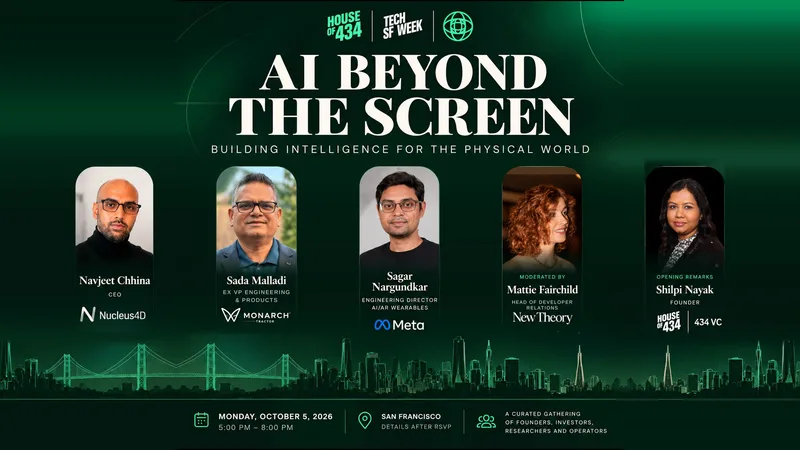
Featuring Sagar Nargundkar — Engineering Director, AI/AR Wearables at Meta https://www.linkedin.com/in/sagargn/ Sagar brings the intelligent-device perspective: how AI changes when it has to live in something people actually wear and use throughout the day. Modern AI glasses sit at the intersection of cameras, microphones, displays, sensors, low-latency compute, wireless connectivity, power constraints and multimodal AI. Meta’s current wearables platform is increasingly opening those capabilities to developers, making the device itself a new computing surface for AI. His perspective will help us unpack a central question of the evening: what happens when AI becomes ambient, always available, and embedded in the physical products around us?
Navjeet Chhina — CEO, Nucleus4D https://www.linkedin.com/in/navjeetchhina/ Navjeet has spent two decades working at the boundary between physical and digital environments. Today, Nucleus4D is building real-world spatial data infrastructure for Physical AI and world models, turning real spaces into machine-usable environments for robotics, simulation, and spatial intelligence.
Sada Malladi — Ex- VP Engineering & Product, Monarch Tractor https://www.linkedin.com/in/sadamalladi/ Sada helped build the engineering organization and software platform behind Monarch Tractor’s autonomous electric vehicles, spanning perception, autonomy, vehicle software, cloud infrastructure, validation and product. Monarch’s technology and assets were acquired by Caterpillar in 2026. TechCrunch His perspective brings us directly into one of the hardest problems in Physical AI: what it takes to move autonomy from software into machines operating every day in unpredictable physical environments.
Moderated by Mattie Fairchild — New Theory https://www.linkedin.com/in/fairchildmattie/ Mattie is deeply embedded in San Francisco’s robotics and Physical AI ecosystem, bringing together builders across robotics, spatial intelligence, hardware, simulation and embodied AI.
Opening remarks Shilpi Nayak — Founder, House of 434 and 434 VC https://www.linkedin.com/in/shilpi-nayak-2a830935/ Shilpi is an investor focused on the intersection of AI, physical systems and the companies building the next generation of intelligent infrastructure and products.
Agenda 5:00 PM — Doors open, drinks and food Meet founders, researchers, engineers, investors and operators working across Physical AI, robotics, wearables, spatial computing, autonomy, edge AI and intelligent infrastructure. 6:15 PM — Welcome from House of 434 6:20 PM — AI Beyond the Screen A deep conversation on the architecture, data, hardware, software and product decisions behind intelligent systems operating in the physical world. 7:00 PM — Audience Q&A 7:15 PM — Drinks, food and curated conversations 8:00 PM — Close Who should be in the room This evening is for people building or thinking seriously about: Physical AI · Robotics · Embodied AI · AI Wearables · Autonomous Systems · World Models · Spatial Intelligence · Edge AI · Real-World Data · Simulation · Hardware + Software Systems If you are building the systems that will allow AI to see, understand and act in the physical world, this conversation is for you.
About House of 434 House of 434 is a community for curious builders and long-term thinkers. We bring together founders, investors, researchers, operators and technology leaders for intimate conversations around important shifts in technology and the people building through them. We care less about collecting business cards and more about creating the kind of room where a thoughtful conversation can become a collaboration, company, investment or friendship.
This event is a part of #SFTechWeek—a week of events hosted by VCs and startups to bring together the tech ecosystem. Learn more at www.tech-week.com.


