
/ About this event
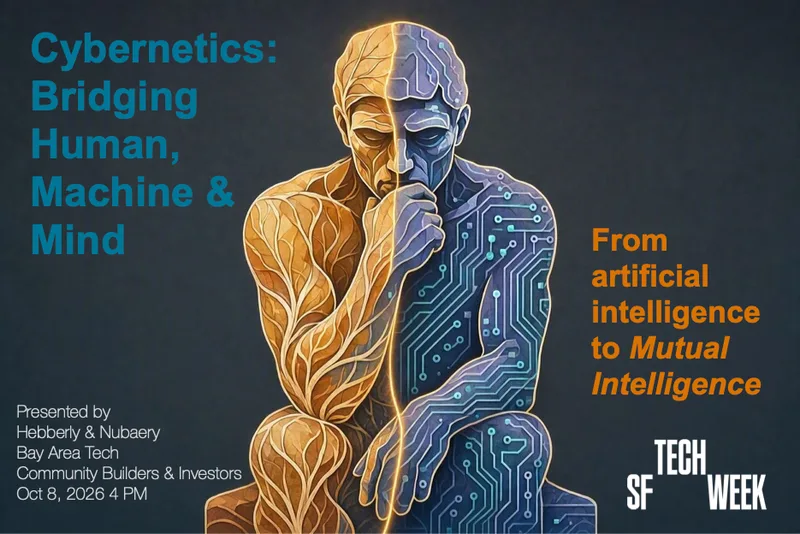
What happens when two forms of intelligence share the same world, but experience that world in fundamentally different ways?
Humans perceive through biology. Machines increasingly perceive through sensors, models, data, and computation. We are beginning to build systems that can see, listen, reason, communicate, act, and even participate in our social environments.
But perhaps the next challenge is not simply creating more intelligent machines. It is learning how humans and machines can understand one another.
Join us for an intimate, interdisciplinary conversation exploring the emerging relationship between biological intelligence and synthetic intelligence—and what it might take to build a future based on cooperation, mutual understanding, and ultimately, symbiosis.
We'll explore this question through several perspectives:
🧬 Biology How do biological systems sense, adapt, learn, communicate, and maintain themselves?
🧪 Biochemistry What happens beneath human cognition and emotion—and what can, and cannot, be translated into computational systems?
🤖 Engineering & Robotics How do we turn perception, cognition, and human interaction into sensors, machines, AI systems, and embodied intelligence?
🧠 Philosophy & Consciousness What do we actually mean by intelligence, awareness, agency, identity, and understanding?
🌌 Contemplative & Alternative Perspectives Are there dimensions of human experience—meaning, intuition, consciousness, spirituality—that challenge purely computational models of the mind?
What should humans teach machines—and what might machines teach humans?
Rather than asking whether AI will become "human," we will explore a different possibility: Can biological and synthetic intelligence learn to understand each other's modes of intelligence without requiring either one to become the other?
Can we move from artificial intelligence toward mutual intelligence? What might this look like in practice?
Understanding how they perceive us, and how we perceive them, may become essential to designing systems that work with humanity rather than simply around it.
Who should attend?
You don't need to be an expert in any of these fields. Bring curiosity, skepticism, experience, and an open mind.
This is intended to be a conversation rather than a conventional technology panel—a place where engineers can talk with philosophers, founders can talk with scientists, investors can meet researchers, and people from very different disciplines can challenge one another's assumptions.
Why "Cybernetics"?
Cybernetics gives us a useful lens for thinking about systems that sense, communicate, adapt, learn, and respond.
As humans and intelligent machines increasingly interact, the question becomes whether we can design systems of interaction that create understanding rather than alienation, cooperation rather than competition, and connection rather than isolation.
Perhaps the future isn't simply about artificial intelligence. Perhaps it is about mutual intelligence.
Join the conversation
This event is a part of #SFTechWeek—a week of events hosted by VCs and startups to bring together the tech ecosystem. Learn more at www.tech-week.com.
🌉 SFTech Week 2026 #SFTechWeek #AI #HumanConnection #FutureOfWork #Community #Technology #Startups


