
/ About this event
AI is becoming powerful enough to act. Now it needs to become trustworthy enough to deserve that power.
Let’s create a sandbox for AI Trust together.
As LLMs and AI agents move from generating text to influencing real decisions, the cost of confident mistakes gets much higher. A polished answer isn’t enough. We need systems that can verify claims, evaluate evidence, surface uncertainty, detect fragile reasoning, and decide when an output is trustworthy enough to act on.
Decision-Grade AI is a Stanford-based panel discussion + buildathon bringing together technical builders to prototype that missing layer.
Over the course of the event, we will have an exclusive panel discussion and buildathon.
☕ Food & Drinks: We've got you covered with coffee, water, refreshing drinks, a delicious lunch, and snacks throughout the event.
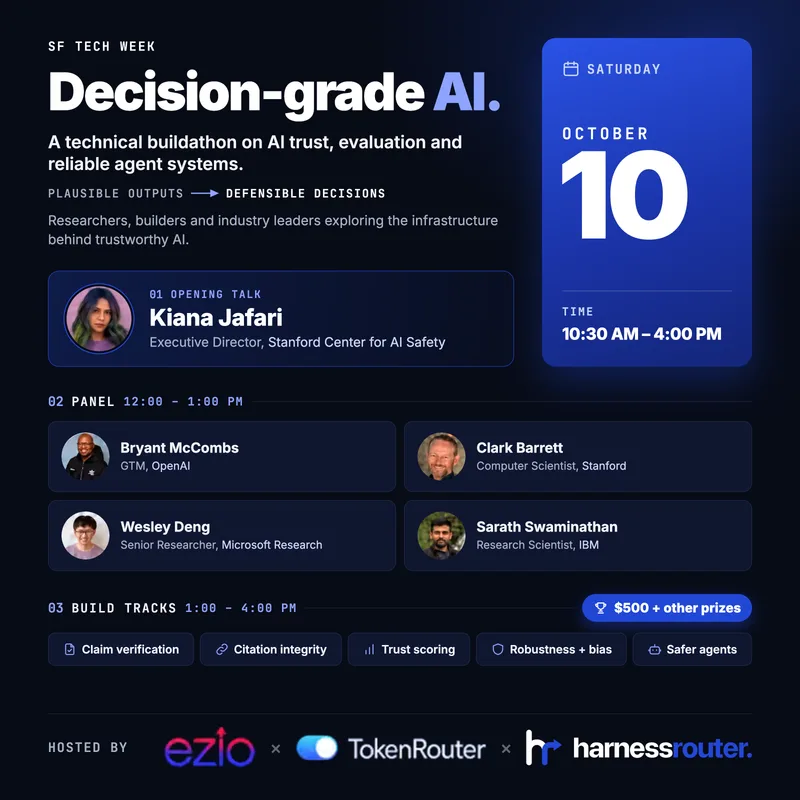
Opening Talk: Kiana Jafari, Executive Director @ Stanford Center for AI Safety
Featured Panelists: Bryant McCombs, GTM @ OpenAI Clark Barrett, Computer Scientist @ Stanford Wesley Deng, Senior Researcher @ Microsoft Sarath Swaminathan, Research Scientist @ IBM
What You’ll Build:
AI is getting better at producing answers. We want to build the systems that determine whether those answers deserve to drive decisions.
SCHEDULE:
10:30–11:00 AM | Check-in, coffee & team mixing 11:00 AM–11:40 AM | Technical kickoff & demos 11:40 AM - 12:00 PM | Opening Talk - Kiana Jafari 12:00–1:00 PM | Expert Panel Discussion (Lunch Afterwards) 1:00–1:15 PM | Challenge reveal & team formation 1:15–3:00 PM | Build with mentor support 3:00–4:00 PM | Final demos, judging & awards
**Snacks throughout
Teams will tackle one of three core challenges -
→ Approval Gate → Before You Act → Build Trust Agent
We’ll start with a technical kickoff introducing the problem space, example architectures, tools, and build directions. After the expert panel, teams will choose a challenge and build with mentor support before presenting working prototypes in final demos.
This is not a hackathon about building another chatbot.
It’s about building the infrastructure underneath the next generation of AI systems - the tools that help answer:
Can we verify this? What evidence supports it? How confident should we be? Should a human or agent actually act on it?
Our team has been exploring these questions through Ezio, where we’re developing approaches to evaluating AI outputs in real time. This buildathon opens the challenge up to a broader community of builders interested in making AI systems more reliable, auditable, and decision-ready.
Who should attend:
CS, engineering, and data science students; AI/ML researchers; software engineers; technical founders; product builders; recent technical alumni; and designers interested in LLM evaluation, verification, model robustness, or agent reliability.
You don’t need prior experience in AI safety.
You just need to want to build systems that make AI harder to fool - and safer to trust.
Exceptional builders. One day. Build the trust layer for AI.
Cohost 1 - TokenRouter Verified Models with Enterprise-grade Controls. TokenRouter helps companies use the world's leading AI models with the security and control their business requires. It brings more than 140 verified models together in one place so teams can build faster and scale with confidence.
Cohost 2 - Ezio Ezio is the trust layer for AI agents and LLM outputs, measuring AI-generated responses before they are used in high-stakes workflows. This event is a part of #SFTechWeek—a week of events hosted by VCs and startups to bring together the tech ecosystem. Learn more at www.tech-week.com
Cohost 3: HarnessRouter HarnessRouter brings 20 of the world’s leading agent harnesses into your product as runtime infrastructure. By combining agent harnesses with models, skills, and tools, builders can create agents for contract review and redlining, academic research, video editing, and more. Every task runs in an isolated sandbox, with managed concurrency and a consistent interface for tasks, sessions, files, artifacts, and traces, helping teams move from prototype to production without operating the underlying agent infrastructure.


